Many food truck operators think about their menu as a list of what they make. Particularly what they do well. Menu engineering treats it as something different: a sales tool deliberately designed to drive customers toward the items that are best for your business. Ones that are both delicious and profitable.
One of the more uncomfortable discoveries operators make when they run a real menu analysis is that their best-selling item may not be their most profitable one. Operators have to know the difference because it changes how to promote, position, and price the items on their menu.
The Four-Category Menu Analysis
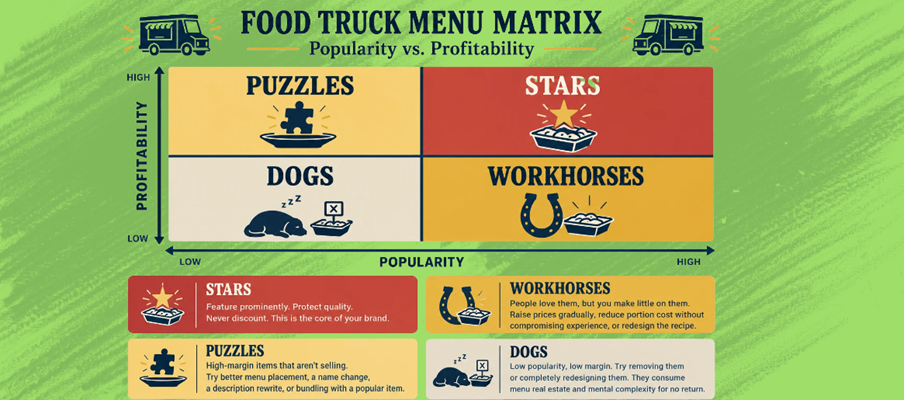
Every item on your menu falls into one of four categories based on two dimensions: how often it sells (popularity) and how much profit it generates (contribution margin after food cost).
|
Category
|
Popularity
|
Profitability
|
What to Do
|
|
Stars
|
High
|
High
|
Feature prominently. Protect quality. Never discount. This is the core of your brand.
|
|
Workhorses
|
High
|
Low
|
People love them but you make little on them. Try raising price gradually, reduce portion cost without compromising experience, or redesign the recipe.
|
|
Puzzles
|
Low
|
High
|
High-margin items that aren't selling. Try better placement on the menu, a name change, a description rewrite, or bundling with a popular item.
|
|
Sleepy Dogs
|
Low
|
Low
|
Low popularity, low margin. Try removing them or completely redesigning them. They're consuming menu real estate and mental complexity for no return.
|
Here's an image for our visual learners...
We recommend running an analysis on your menu like this quarterly using your sales data and food costs. The matrix won't tell you what to do definitively, but it will empower you to make better, more profitable choices.
Lessons Learned in the Trenches
Smaller Menus Outperform Bigger Ones
Look at everything from the perspective of the customer's journey. Food truck customers are reading your menu while standing in a service line, sometimes in variable light or weather and if you’re running shop right, making a decision in under 90 seconds. A menu with 20 items creates decision paralysis. A menu with 6 to 10 items is far easier to navigate.
Research on menu design consistently shows that smaller menus produce higher average transaction values and higher customer satisfaction.
If you have more than 12 items worth serving, consider a rotating specials board that changes seasonally rather than a permanently expanded core menu. This keeps the core menu tight, gives regulars a reason to try something new, and lets you test potential additions.
Pricing Psychology That Works
-
Remove dollar signs from menu prices. "Bowl 12" reads faster and feels less expensive than "Bowl $12.00"
-
Anchor with one premium item. A $24 premium bowl at the top of the menu makes every $11 to $14 option below it feel like a reasonable value. Without the anchor, the same $13 bowl is evaluated in isolation. It’s the same trick used in grocery stores when you enter the aisles.
-
Bundle for ticket size. A main plus a side plus a drink for a bundled price that's roughly 80% of individual prices increases average transaction value while feeling like value to the customer.
-
Avoid pricing everything at clean round numbers. $11.50 often outsells $12. Don’t ask us why it works; we’re not psychologists.
Seasonal Rotation as a Menu Strategy
Seasonal menu rotations serve two strategic purposes simultaneously. First, they give regulars a reason to come back and try something new; which matters enormously for the retention strategies we covered in our article on the top tactics to build a loyal base. Second, they let you optimize for seasonal ingredient cost fluctuations. It also lends to creating limited-time items with scarcity. This makes for urgency and easy social media content.
Test Before You Commit
In the end, before adding any item to your permanent menu, run it as a special for two to four weeks and track three things: sell-through rate, the margin (try using the pricing methodology from our 2026 menu pricing guide), and unprompted feedback from customers who tried it. Items that score well on all three earn a permanent spot.
Your menu is so much more than your personality and niche on a dish; it's your map to profitability and customer loyalty.
***
Hi! We're MOBLZ and we make it easy for food truck operators to find repeat customers and book winning lunch rotations at no cost to the operator. Join our vendor list today.
P.S. We never EVER take from your cut.